How to improve your CV: a checklist that actually gets interviews
A concrete checklist to improve your CV: job-match and missing keywords, stronger bullets, and a cleaner layout.

If you are searching for how to improve your CV, you do not need another template. You need a version of your experience that a tired recruiter can map to one job in ten seconds, and that recruiter filters can read without dropping half your skills.
1. Start from the job, not from last year's file
Open the posting and highlight must-have skills, tools, and outcomes. Then open your CV and mark every line that proves one of those items. Anything unmarked is a candidate for cutting or moving down. This single pass does more to improve a CV than rewriting the summary three times.
2. Write bullets as evidence, not job descriptions
"Responsible for managing a team" is a duty. "Hired and coached a team of 6 that shipped a checkout redesign, lifting conversion 11%" is evidence. Aim for verb + what you did + who it helped + a number when you have one. If you lack a metric, use scale (users, markets, budget, frequency).
3. Close the keyword gap honestly
Recruiter filters match tokens. If the job says "SQL" and your CV only says "databases", you may never be seen. Add the real tools you used. Do not paste a keyword cloud. A dedicated keyword pass, or an AI CV checker that lists missing terms, is the fastest way to catch this.
4. Put the fit above the fold
- Headline or title line that matches the role (e.g. "Backend engineer · Python, AWS").
- Two-sentence profile that names the domain and the outcome you are known for.
- Most relevant role first, even if it is not the most recent. Or lead that recent role with the relevant project.
5. Clean the document so humans and software can read it
- Use a single-column layout for online applications.
- Avoid text in images, icons-only skill bars, and tables that break parsers.
- Keep dates consistent (MMM YYYY) and file names professional.
- Export a PDF and a plain-text check: if paste-into-Notepad looks chaotic, so will many first-screen filters.
6. Run a targeted rewrite, then a human edit
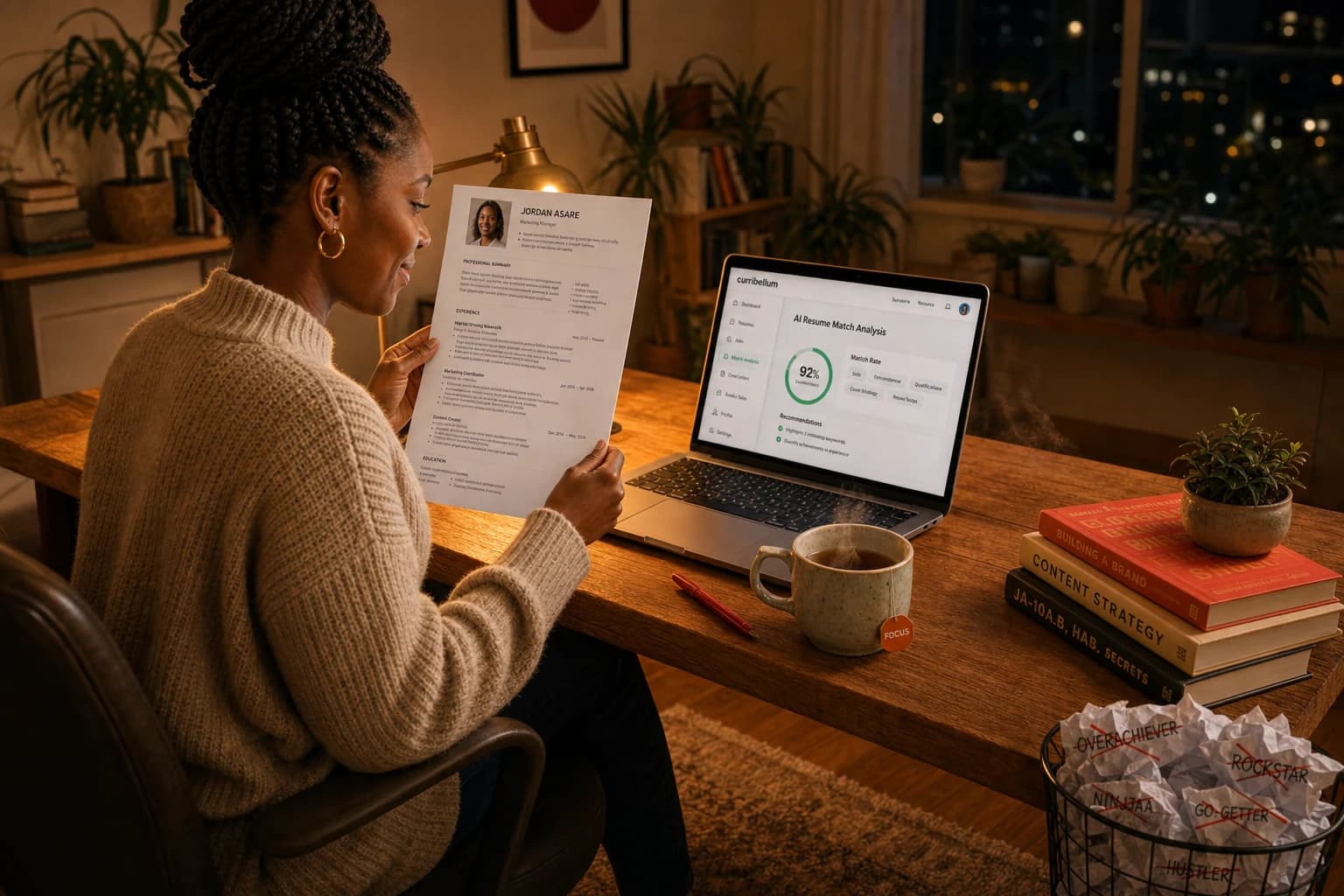
Once the structure is right, use AI to improve your resume for that specific offer: match score, missing keywords, and a full rewrite. Then you edit. You own the facts; the model owns the first draft of clearer sentences.
A 20-minute improve-your-CV session
Pick one posting. Upload your current CV to Curribellum. Spend ten minutes on the suggested keyword and bullet fixes, five minutes deleting anything that does not serve this role, and five minutes reading the rewrite out loud. That is enough to send a stronger CV the same day.
Also useful: Resume vs CV: formats that work in the US, UK, France, and Germany, How to pull resume keywords from a job offer (without stuffing), How to improve your resume with AI (without sounding generic).